
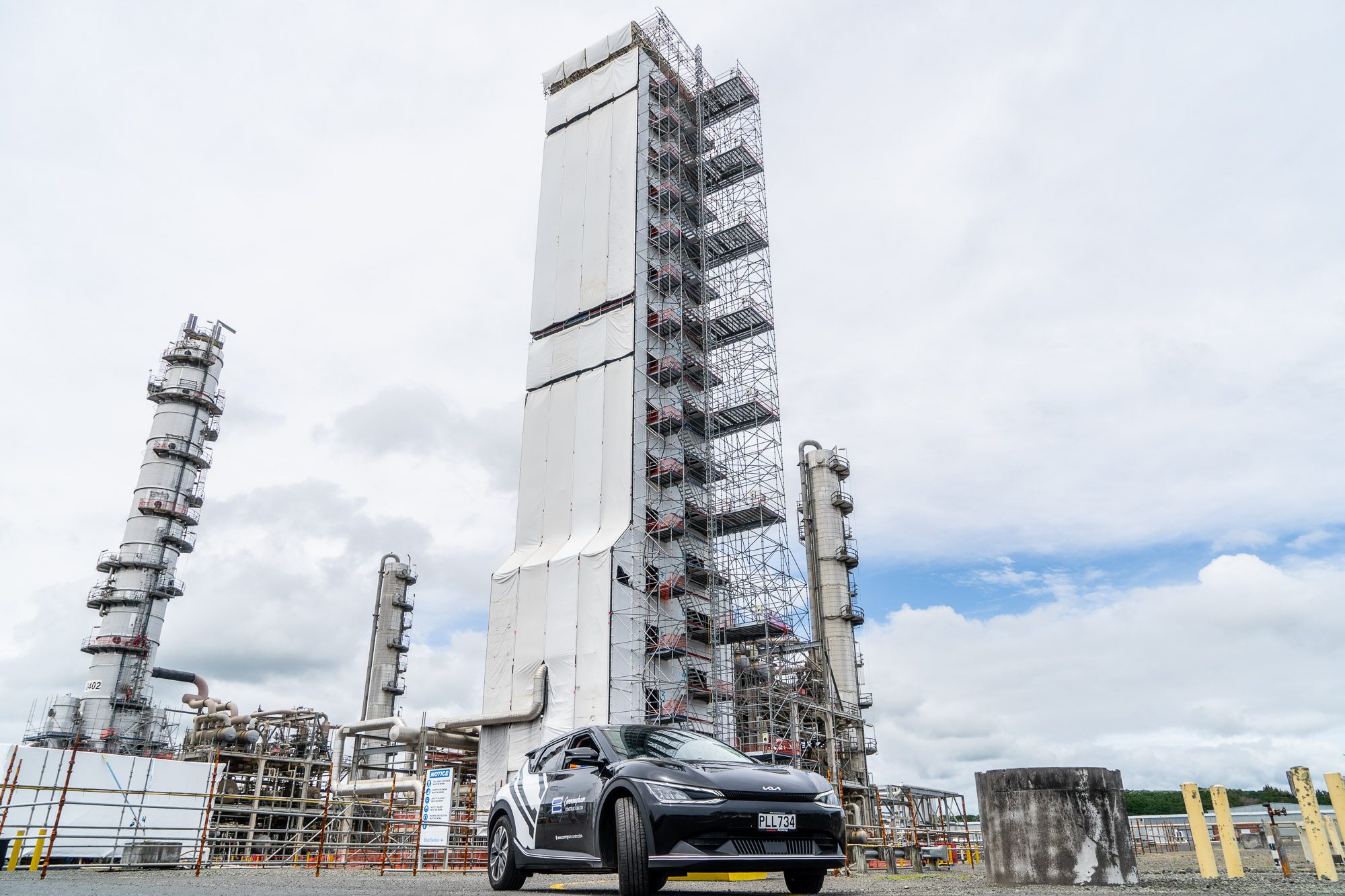
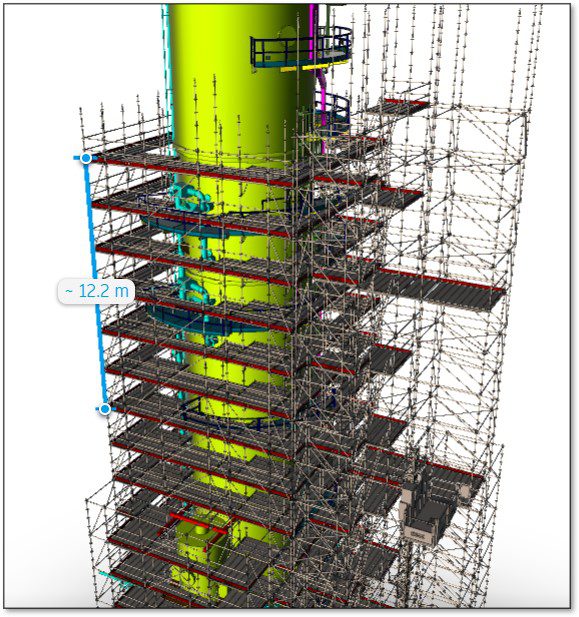
Cunningham Construction Limited were engaged by Methanex NZ to replicate our completed Distillation 3 (D3) scaffold on the neighbouring column Distillation 4 (D4). CCL had achieved some fantastic environmental outcomes with D3 and with the identical footprint CCL set out to conquer this one in the same starting fashion. This involved engaging local surveyors BTW for a full aerial survey and 3D laser scan of the column. From there, the 3D scan was sent offshore to decipher, clean up and format for use with our CAD designers. Once this was achieved Edgar from Layher was able to begin his magic resulting in the scaffold design overlay utilising the 3D model in all its glory.
Clashes (down to the millimetre) were eliminated which was front and centre right from the base out stage with the individual 84 screw jacks lasered in and set with our scaffolding crew working with the surveyors onsite.
Even though the mandate was to replicate what we had built on D3 we took the liberty to tweak things and improve things where possible. This was driven by both Willy Lane and Jayden Wilson at the coal face and executed perfectly by the Cunninghams boys onsite. Due to the scaffold having to avoid every bit of pipework coming off the column the design required us to fabricate 500 ledger to Keder rail components from a local manufacturer (Steelfab) this meant we could start in one corner coming off on an angle and use 4 keder sheets per side, with one custom sheet made at just over 2.316m to complete the 3 sides. We used Keder snake components on D4 to navigate the reboilers on the column allowing us to go top to bottom in the reusable Keder sheeting unlike D3 (where the bottom 20m was shrinkwrap).
110 tonne of Layher scaffolding with a intuitive way of managing the full containment by splitting the sheets for airflow. The scaffold has held up to Cyclone Gabrielle’s full force and the engineering and design behind this one make the job a really unique one that has created huge efficiencies for our client.
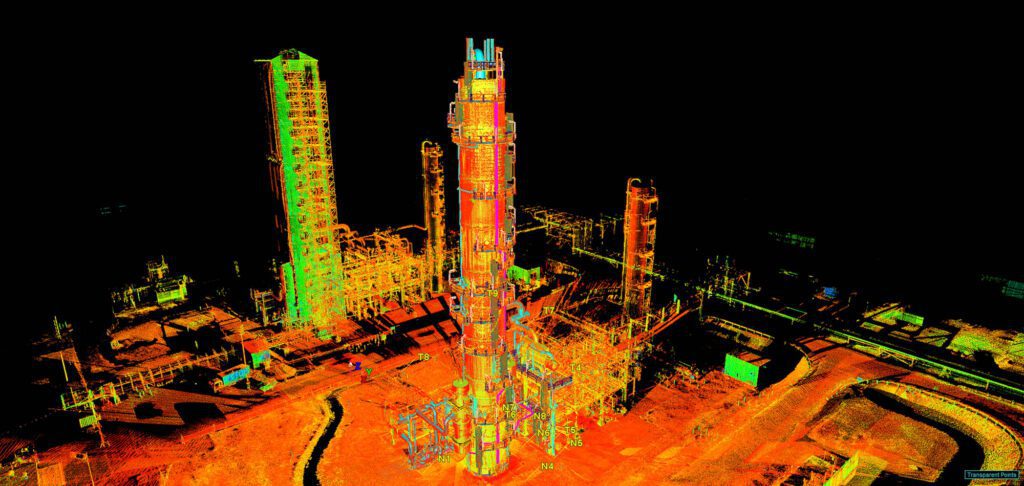
Full aerial survey and 3D laser scan of the column, conducted by BTW.
Rodrigo Winkler was the engineer responsible for the certification of this scaffold. It was challenging having a 70+ meter tall fully enclosed structure in located in an exposed wind zone. Additional strengthening members, constant wind monitoring and subsequent wind restrictions, were all required during the project. Cunninghams and Rodrigo worked very closely throughout the job to ensure the structure always remained safe.
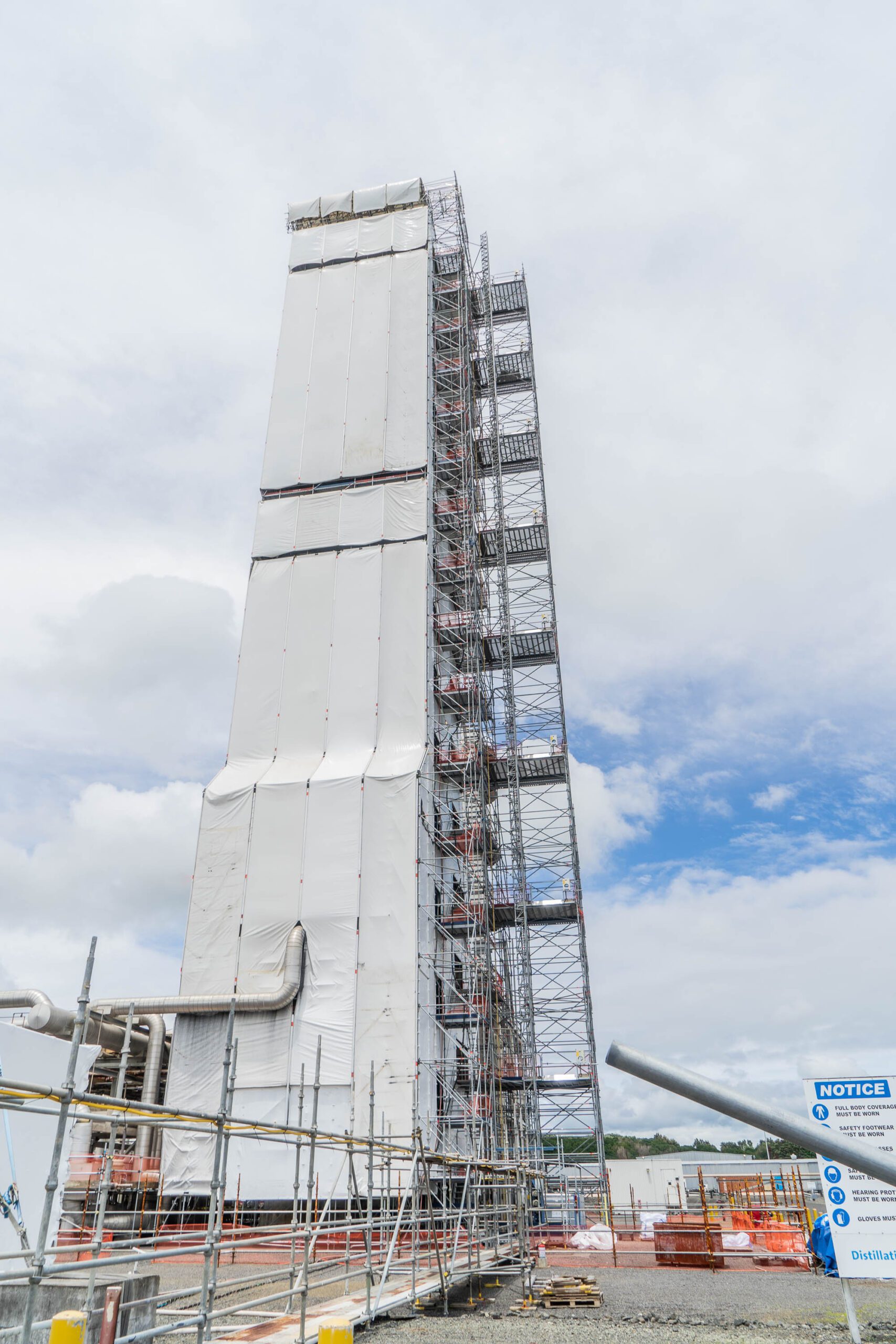
“From the initial start date, the 75m, 110 tonne scaffold was handed over to the client for use in 8 short weeks. This was the result of a highly motivated team of 10 men. Apart from the roof sections, This build was completely self-sufficient, using only our Geda Lift to transport the equipment. One aspect we incorporated to reduce the carbon footprint of the scaffold, is that we chose to use Kedar sheeting on three of the sides, top to bottom. Not only did this choice aid in reducing the amount of shrink wrap waste and LPG used, but The sheets could also then be reused on future projects. With the scaffold subject to the impacts of high wind loading, the choice was made to cut our Kedar wall sheeting into segments. This would allow us to remove the top 5m sheets with ease in the case of forecasted winds of 60km. Additionally, the middle 5m sheets would be removed in forecasted conditions of 80km.”
Jayden Wilson
Cunningham Construction
Site Scaffold Supervisor
"The scope given to us by CCL is to design a fully encapsulated access scaffold at least 1.09m wide x 68.00m high for the Methanex distillation tower D4. This is almost identical to D3 which CCL have already finished successfully.
Learning from D3, CCL have fully scanned the D4 tower so we can have a 3D model (“digital twin” of existing structure) which can be used for our preliminary designs. This was very helpful for our design process and only a few customers here in NZ are willing and able to go to this extent of planning. The 3D model, as I know, was made overseas from scans done by a local company. The whole process took almost a couple of weeks but saved everyone a lot of time not having to go to site to do individual checks and measurements.
We were guided every step of the design process with extensive collaboration between CCL’s managers and site team. From placement of individual legs to decisions about avoiding clashes or managing gaps, the design process was very smooth and easy.Edgardo Escaro Jr
Layher New Zealand
Technical Manager